


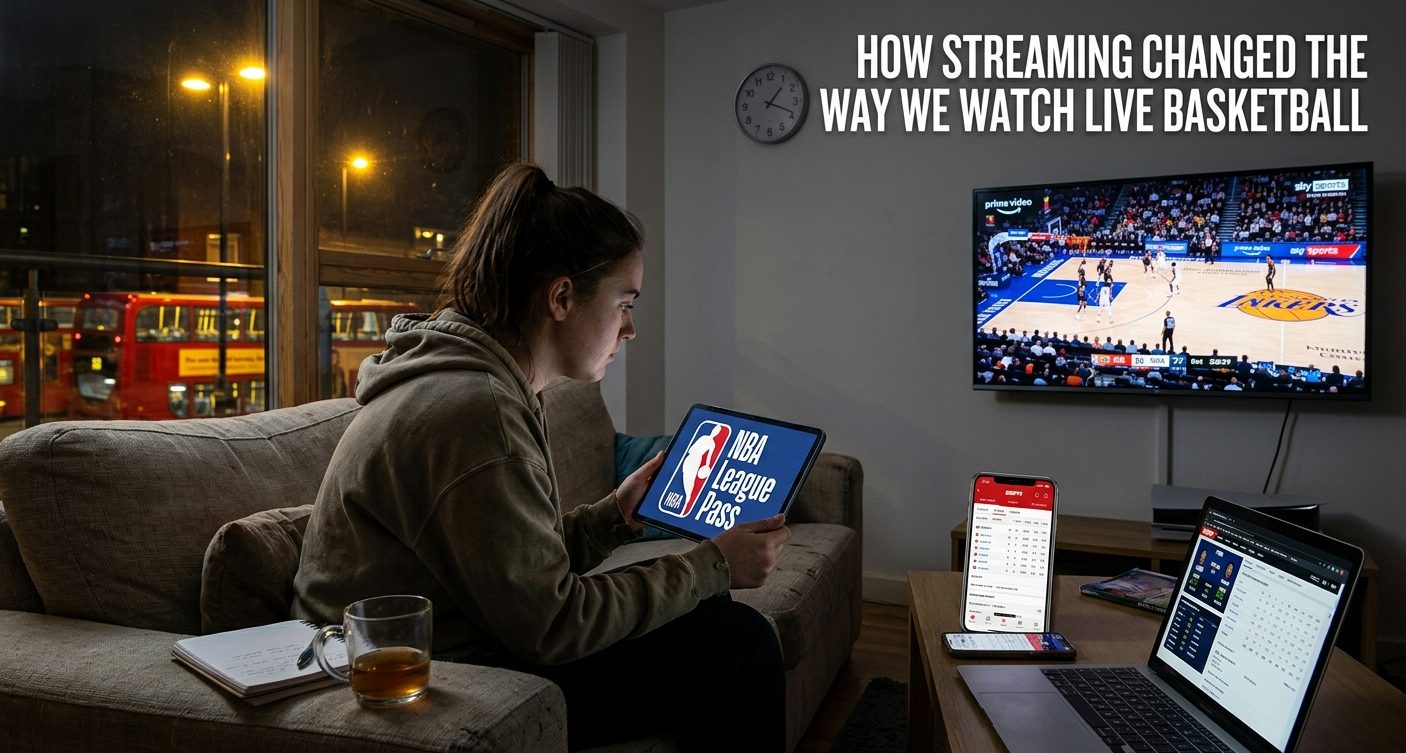
If you follow the NBA from the UK, you already know the routine. Tip-off is at half past midnight. The game finishes after 3 a.m. And you have work in the morning.
Not so long ago, that left you two choices: stay up and suffer, or go to bed and avoid your phone until the highlights appeared. Streaming has changed that. It hasn’t removed the time zone problem, but it has given fans far more ways to deal with it.
Here’s how streaming has changed the way we watch live basketball, what it’s cost us along the way, and how to set yourself up without paying for everything.
The old way: one channel, one schedule
For years, watching live basketball meant a fixed schedule on a fixed channel. If your broadcaster showed one game a week, that was your week. If the game you wanted wasn’t picked, you waited for a ten-minute highlights package.
That model had its charms. Everyone watched the same game at the same time, and the next day’s conversation was easy.
But it left a lot of fans on the outside, especially anyone who wanted to follow a particular team rather than whichever one the schedule happened to pick.
What streaming actually changed?
The shift isn’t just “we watch on apps now.” Several things are genuinely different:
- Choice of game. With a league-wide subscription like NBA League Pass, you can watch almost any game rather than whatever is on TV. Because the UK has no NBA team, UK subscribers generally aren’t hit by the local blackouts that US fans deal with.
- Watching on your own time. Full-game replays and condensed versions mean a game that finished at 3 a.m. can be watched over breakfast or on the commute, in 20 minutes if you like.
- Any screen. Phone, tablet, laptop, games console or smart TV. A match is no longer tied to the living-room set.
- Extra information. Live stats, multiple camera angles and alternative commentary are common in streaming products, and give fans more to look at than the standard broadcast.
- More competition. When several companies bid for the same games, fans get more places to watch and, at times, better products.
The biggest change of all is control. The fan now chooses when, where and how to watch, instead of the broadcaster deciding for them.
The rights shake-up that brought streaming to the centre
The clearest example came with the NBA’s 11-year media deal, which began with the 2025-26 season. In the UK, live games are split between Sky Sports, which carries a package of NBA games through NBCUniversal, and Prime Video, which streams its own selection.
Amazon’s UK arm described how Prime Video would show NBA games to members in the UK and Ireland in its first season, including the NBA Finals in June 2026, which it said would be the first time the championship series reached Prime members here. Sky has also said WNBA coverage will begin from the 2026/27 season.
Amazon is also positioned as a distributor of League Pass, the league’s own subscription service. So the same company that streams games now also helps sell the product built to replace the old TV schedule.
Did the move to streaming hurt the audience? On the evidence so far, no. The NBA says in its Finals release that the 2026 postseason was its most-watched in 28 years across ABC/ESPN, Prime Video and NBC/Peacock.
The Finals itself averaged 20.6 million viewers on ABC and ESPN alone. Streaming appears to be adding viewers, not just moving them around.
The downside: costs and confusion
More choice has a price, and not just the subscription. Fans now run into problems the old model didn’t have:
- Stacking subscriptions. A fan who wants every game might end up with a sports channel, a streaming service and a league pass. That adds up quickly.
- Where is the game? With games split between providers, finding out where tonight’s match is shown can take longer than it should.
- Changing rights. Deals move. The broadcaster you used last year may not have the games you want this year.
- Spoilers. Streams often run behind live broadcasts, so a notification or social post can reveal a result before you see it.
- Less shared viewing. When everyone watches on their own schedule, the communal buzz of a big game tends to thin out.
Those costs are real, and anyone who tells you streaming is simply better is skipping over them.
Building a sensible setup
You don’t have to pay for everything. Think about how you actually watch, and match the service to it.
- The casual fan. Watch the games your existing providers show, plus the playoffs and the Finals. This costs the least and covers the big moments.
- The team follower. If you care about one team, a league-wide pass lets you watch every game they play, live or on demand.
- The die-hard. You’ll probably want the full set. Look at the cost over a whole season and see whether combining services beats paying for a league pass alone.
- The time-poor. Skip live viewing for most games. Use condensed replays and catch the full game only when it matters.
One practical tip: check what is available before committing. Rights and prices change, and a provider’s own page will always be more current than an article, including this one.
Handling the late-night problem
Streaming helps with the clock, but it doesn’t solve it. Most UK fans end up with a mix of habits:
- Pick your live games. Stay up for the ones that truly matter: your team in a big game, a playoff series or a star’s milestone night.
- Watch replays for the rest. A full replay at a sensible hour feels completely different from a 3 a.m. one.
- Avoid spoilers on purpose. Mute your team’s name on social apps until you’ve watched.
- Get a morning summary. A daily email is a good way to know what happened overnight without scrolling. Basketballloop sends one every morning with scores, storylines and film breakdowns, which is handy for deciding which replay is worth your time.
What gets lost along the way?
Streaming gives fans control, but it takes away some of the old rituals. Appointment viewing, where everyone settles in at the same time, matters less when the game is always available later.
There’s also the question of attention. With endless options, it’s easy to watch ten minutes of five games and finish none. The best streaming habit may be the old one: choose a game and watch it properly.
Where this is heading?
Expect more of the same, with refinements. Platforms are adding richer stats during games, more personalised feeds and more ways to jump straight to the moments you care about. Women’s basketball is gaining a bigger presence in UK schedules too.
The core appeal won’t change, though. Fans want to see great basketball without giving up their sleep, their budget or their sanity. Streaming has made that more possible than ever, as long as you’re deliberate about how you use it.
Pick a setup that fits your life, protect your spoilers, and save the late nights for the games that earn them.