


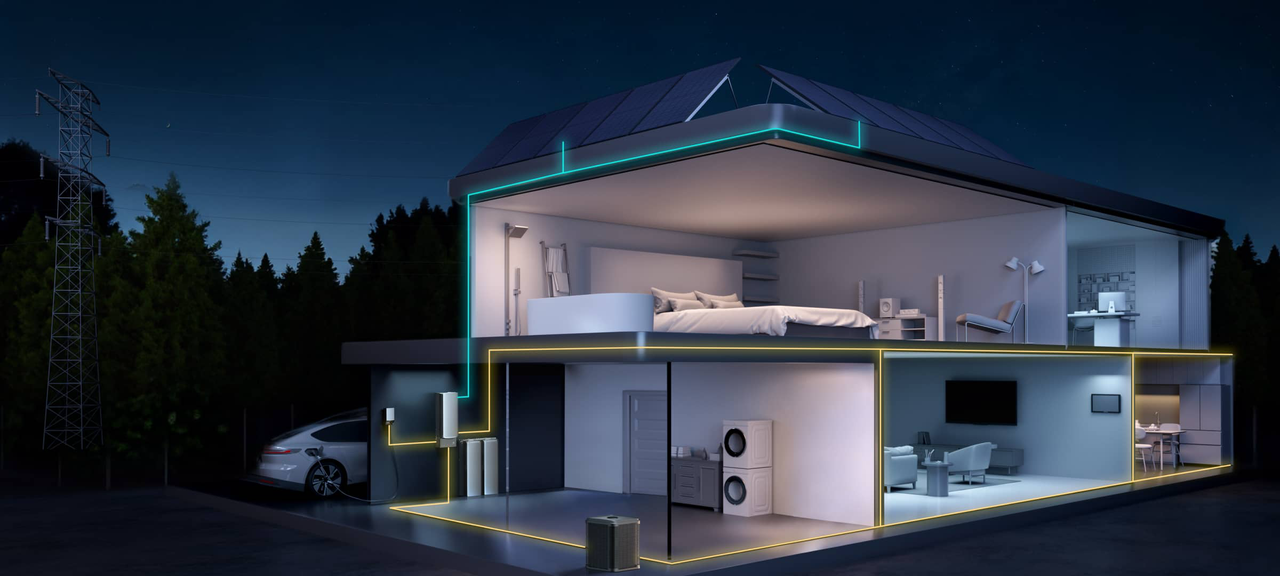
Not long ago, energy was something families rarely thought about. You paid your utility bill, kept the lights on, and fueled your car at the nearest gas station. But today, things are shifting. With energy costs rising, outages increasing, and electric vehicles becoming mainstream, power is no longer just a background service—it’s a lifestyle decision.
Across North America, homeowners are beginning to ask a new set of questions: How can I make my home more independent? How do I protect my family from grid instability? And perhaps most importantly—how do I do it without sacrificing comfort?
The answer often starts with one of the most abundant resources available: solar power for your home.
Why solar is the foundation?
The sun provides more energy in a single hour than the entire world uses in a year. For homeowners, that’s an opportunity hiding in plain sight. Solar panels enable the capture of part of that resource and its conversion into clean electricity for daily use.
For families, the benefits are straightforward:
- Lower bills: Every watt produced at home is one less you buy from the utility.
- Eco-friendly living: Solar reduces dependence on fossil fuels and cuts carbon emissions.
- Independence: Generating your own power means less vulnerability to grid failures.
EcoFlow simplifies the process by offering options that suit a variety of lifestyles. Portable panels are foldable, lightweight, and perfect for camping or emergency backup. Rigid roof-mounted panels are more durable and perform better, lasting longer and providing an excellent output.
For example, with the PowerStream Balcony Solar System, the system is combined with a battery to store excess energy during the day and use it during the night.
But there’s a catch—panels alone aren’t enough. The fundamental transformation happens when you pair solar with storage.
Turning solar into 24/7 power
Here’s the challenge: the sun doesn’t shine at night. Without storage, much of your solar power goes unused, and you’re still tied to the grid during peak evening hours.
That’s why adding a solar battery is such a game changer. A battery holds onto the energy your panels create so you can use it whenever you need it—during an outage, at night, or when rates spike.

EcoFlow’s lineup offers something for every home:
- DELTA Pro Ultra: Expandable from 6kWh to a massive 90kWh, it’s ideal for families that want long-term whole-home backup.
- DELTA Pro: A portable system starting at 3.6kWh, expandable up to 25kWh, and compatible with various charging methods—including EV stations.
- RIVER series: Compact and portable for camping trips or short-term outages.
- OCEAN Pro Home Solar Battery Solution: A high-capacity, AI-powered option with up to 180kWh of storage. It integrates solar, grid, and generator power, ensuring you’re covered in any situation.
Adding storage changes solar from a daytime-only solution into a full 24/7 shield of reliability. For many families, it’s the difference between treating solar as a “bonus” and treating it as their primary energy source.
Why EV integration matters?
Electric vehicles are gaining popularity across North America. That’s good news for the environment, but it adds new challenges for households. Charging an EV directly from the grid, especially during peak hours, can be expensive. And public charging stations aren’t always reliable.
This is where the EcoFlow OCEAN EV Charger makes a difference.
The solar EV charger isn’t just about faster charging (though it delivers up to 46 miles of range per hour). It’s about smarter charging. Paired with EcoFlow’s solar and battery systems, it can:

- Prioritize stored solar energy for charging your car, keeping costs low.
- Schedule sessions for off-peak hours when grid rates are cheaper.
- Offer real-time monitoring and control through the EcoFlow app.
It also fits naturally into North American households, with a standard SAE J1772 connector, Wi-Fi and Bluetooth connectivity, and a weatherproof design for garage or outdoor use.
The result? Your home becomes not just a place where you live but your personal fueling station—powered by the sun.
Everyday advantages beyond the big picture
Energy independence isn’t only about being green or saving money. It’s about the daily comforts that often go unnoticed until they’re gone.
- Comfort through storms: HVAC systems keep running even if the grid fails.
- Food safety: Refrigerators maintain a cold temperature, protecting groceries and medications.
- Peace of mind: No noisy gas generators, no late-night fuel runs.
- Connectivity: Laptops, phones, and Wi-Fi keep families working, learning, and communicating.
These everyday perks turn independence into more than a backup plan—they make it part of daily living.
EcoFlow lineup tailored to family needs
One reason EcoFlow stands out is its versatility. Families don’t have to commit to a one-size-fits-all setup. Instead, they can choose systems that fit their home, lifestyle, and budget.
- Large households may choose the OCEAN Pro or DELTA Pro Ultra for full coverage.
- Mid-sized families often find the DELTA Pro or DELTA Pro 3 a practical fit.
- On-the-go users benefit from RIVER series solutions for camping or emergencies.
- EV drivers complete the ecosystem with the OCEAN EV Charger, tying transportation into their home energy system.
This flexibility means independence isn’t all-or-nothing. Families can start small and expand as their needs grow.
More intelligent control at your fingertips
What ties all of this together isn’t just the hardware—it’s the intelligence behind it. The EcoFlow app acts as the brain of the system.
Want to see how much solar energy you generated today? Done. Do you need to prioritize which appliances receive power during an outage? Easy. Looking to save money by charging your EV overnight instead of at peak hours? Just a few taps.
For many families, this control is what makes energy independence practical. It’s not about tinkering—it’s about confidence and simplicity.
The financial case
Of course, cost savings remain a major driver. And the financial benefits are clear:
- A 30% federal tax credit for solar and storage in the U.S.
- Additional state-level incentives are available in places like California, Texas, and Florida.
- Ongoing bill reductions of 30–40% with AI-optimized systems.
- Potential income from selling surplus energy back to the grid through Virtual Power Plant (VPP) programs.
These savings, paired with extended warranties (up to 15 years on major systems), make the investment practical as well as sustainable.
The community ripple effect
Independence at the household level also strengthens neighborhoods.
- Homes with backup reduce strain on the grid during peak hours.
- Cleaner air and quieter streets when families opt for cleaner energy sources.
- Faster community recovery after storms when fewer households are left powerless.
Prepared households don’t just help themselves—they help stabilize their communities.
Looking ahead: homes as energy hubs
The direction is clear. Homes are evolving from energy consumers into energy hubs. They generate, store, and manage their own power. They charge cars. And in some cases, they contribute back to the grid.
For families in North America, this shift represents both independence and opportunity. It’s not only about keeping the lights on. It’s about reshaping how energy fits into daily life.
Conclusion: independence made practical
The future of home energy is no longer futuristic—it’s here. With solar panels, batteries, and smart EV chargers, North American families can cut costs, reduce stress, and live greener without giving up comfort.
EcoFlow’s ecosystem makes that possible, whether it’s a portable solution for a weekend camper or a full-scale system that powers an entire home and an EV.
Independence is no longer a distant goal. It’s a practical step toward comfort, resilience, and peace of mind—one that more households are ready to take.